Choosing the best Bed Side Cabinet from China requires more than comparing prices and attractive product photos. A reliable choice should balance material quality, storage, stability, safety, and supplier communication. The cabinet beside your bed may look simple, yet it carries daily essentials, charging devices, books, and sometimes a glass of water. Small details matter. Drawer alignment matters. So does the smell of fresh paint.
China offers extensive bedside furniture options, from compact plywood cabinets to solid wood models with soft-close drawers. However, variety can create confusion. A low price may reflect efficient manufacturing, or it may signal thinner panels and weaker hardware. Buyers should request material specifications, finish details, load capacity, packaging photographs, and inspection records. Certifications should also match the destination market. Samples remain valuable. A beautiful catalog image is not proof of durable construction.
Dieter Rams, a widely respected industrial designer, said, “Good design is as little design as possible.” This principle fits a practical Bed Side Cabinet: clean proportions, useful storage, safe edges, and no unnecessary decoration. Still, minimal design does not guarantee comfort or longevity. A cabinet with a narrow base may look elegant but tip easily on an uneven floor. A glossy surface may photograph well but reveal fingerprints every morning.
This guide examines Chinese Bed Side Cabinet suppliers through practical evidence, not promises alone. It considers craftsmanship, customization, production consistency, communication, and after-sales reliability. There is no perfect cabinet for every bedroom. The strongest option is the one that fits your space, budget, habits, and quality expectations.
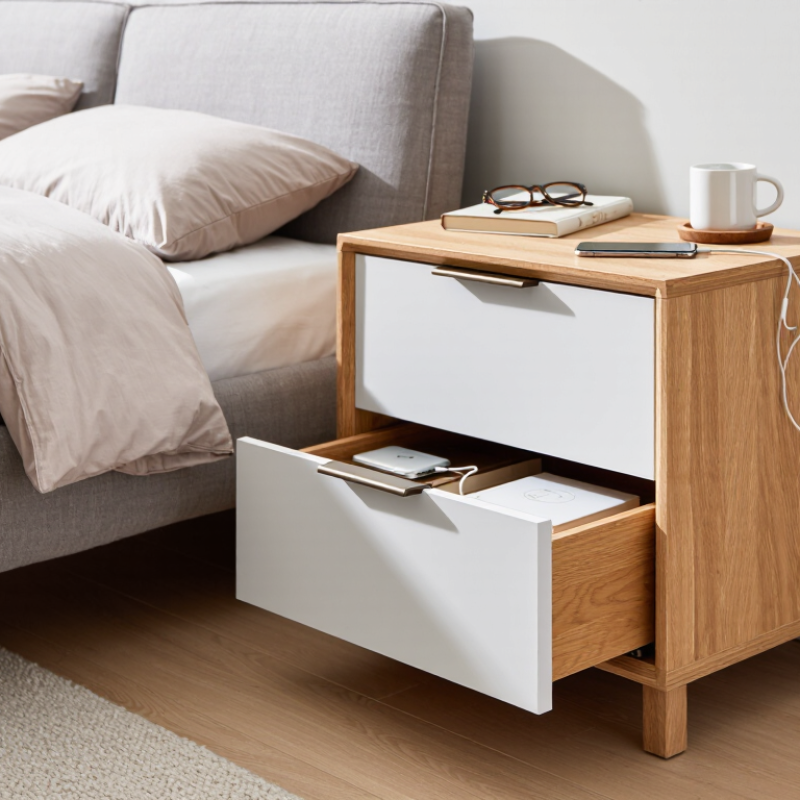
What Is the Best Bedside Cabinet from China?
Types of Bedside Cabinets Made in China
Chinese bedside cabinets come in several practical forms. Solid wood cabinets offer visible grain, firm construction, and a warmer bedroom appearance. However, wood can expand in humid rooms. Ask about moisture control before ordering.
MDF and particleboard cabinets usually provide lower-cost, consistent shapes. Melamine or painted surfaces are easy to clean. They suit rental rooms and large furniture projects. Check edge sealing carefully. Poor sealing may allow moisture to enter and weaken the board.
Metal bedside cabinets create a cleaner, more industrial look. Powder-coated steel resists everyday scratches, but thin panels may feel less stable. Upholstered cabinets add softness and reduce sharp corners. They need more careful cleaning. Rattan and bamboo styles bring texture and airflow, though natural materials may vary slightly in color.
Wall-mounted cabinets save floor space and make cleaning easier. Drawer cabinets protect medicines, books, and personal items from dust. Open-shelf designs offer quick access, but they can look untidy. Some factories also produce cabinets with charging ports, hidden cable routes, or soft-close runners. Test these parts with a sample.
From my inspection experience, smooth drawer movement matters more than decorative details. Measure the bed height, wall clearance, and socket position before choosing. A sample may look excellent, yet hardware alignment can change during mass production. That risk deserves written quality checks.
A reliable bedside cabinet begins with the right material. Solid wood offers strength and a warm, natural surface. Bamboo is lighter and renews quickly, but its joints need careful inspection. MDF with a quality veneer can control cost and provide a smooth finish. However, poorly sealed edges may swell near damp floors. Check panel thickness, surface bonding, drawer alignment, and odor before ordering samples. Ask for material specifications and independent safety test reports. That is not excessive.
Design should support real bedroom habits. A cabinet around 45 to 60 centimeters high usually aligns with most mattresses. One deep drawer can hide books, medication, or charging cables. An open shelf keeps a lamp or alarm clock within reach. Rounded corners reduce painful bumps during nighttime movement. Stable legs matter on uneven floors. Anti-tip fittings are worth requesting, especially in homes with children. Some designs look elegant but waste useful space.
Tips: Test the drawer with one hand. It should slide quietly and close evenly. Request a sample before bulk production. Compare the cabinet’s actual color under warm and daylight lighting. Check whether the cable hole matches your charger. I once overlooked a narrow drawer base, and it reduced storage more than expected. Measure first. Beauty cannot fix poor proportions. Ask about moisture resistance, hardware replacement, packaging protection, and inspection procedures before shipment.
What Is the Best Bed Side Cabinet from China?
Quality Standards for Chinese Bedside Cabinets
A reliable Chinese bedside cabinet begins with controlled materials, not attractive photographs. Check the board’s moisture content, density, and formaldehyde emission test results. Documents should identify the testing laboratory and production batch. Ask for recent reports, because old certificates may not represent current materials. Solid wood also needs stable moisture control, usually around 8% to 12% for indoor furniture.
Construction details reveal practical quality. Inspect whether edge banding is firmly sealed, especially around drawers and the back panel. Run each drawer at least twenty times. It should move smoothly without scraping or tilting. Hinges must hold alignment after repeated opening. A useful load test places books inside the drawer and applies gentle pressure to the cabinet top. The unit should remain level. Small gaps are not always dangerous, but uneven gaps often signal rushed assembly.
A factory inspection should include random checks from finished cartons, not only a perfect showroom sample. Packaging deserves attention too. Corner protectors, moisture barriers, and drop-test records can prevent damage during long-distance shipping. I would not accept vague claims about “premium quality.” Clear inspection standards are more dependable. Still, no inspection catches everything. A minor surface flaw may appear after installation, so the supplier should offer traceable replacement parts and written corrective procedures. That detail often separates a dependable cabinet from a merely attractive one.
| Quality Dimension | What to Check | Practical Acceptance Target | Verification |
|---|---|---|---|
| Dimensions and bedside fit | Overall height, width, depth, drawer clearance, and available space beside the bed. | Choose a height close to the top of the mattress for convenient access. Confirm the final dimensions against the room layout; there is no single standard size for all bedside cabinets. | Review a dimensioned drawing and measure a finished sample, including handles and other projecting parts. |
| Panel emissions | For wood-based panels, check the declared formaldehyde-emission class and the test report for the actual panel type. | For panels tested under GB/T 39600-2021, the commonly used classes are E1 (≤0.124 mg/m³), E0 (≤0.050 mg/m³), and ENF (≤0.025 mg/m³). These are panel classifications, not a guarantee of whole-room air quality. | Request a valid laboratory report identifying the panel, test method, result, and emission class. Confirm any destination-market requirements separately. |
| Structural strength and durability | Check the cabinet body, drawer runners, joints, legs, and resistance to repeated opening and loading. | Require stable operation without loosening, cracking, or significant deformation under the loads and use conditions specified in the purchase specification. | Use an agreed test plan; ISO 7170 provides methods for testing the strength, durability, and stability of storage units. |
| Tip-over stability | Assess the risk of the cabinet tipping when a drawer is open or loaded, particularly in homes with children. | The cabinet should remain stable under the applicable safety test conditions. Provide a suitable wall-attachment device where required by the design or destination-market rules. | Request stability-test evidence for the finished configuration. EN 14749 includes safety requirements and test methods for domestic storage furniture in its scope. |
| Drawer performance | Check smooth travel, alignment, usable storage space, stop function, and consistency across drawers. | Drawers should open and close without binding, excessive side-to-side movement, or unintended release during normal use. | Operate each drawer repeatedly on a sample and inspect runner attachment, clearances, and alignment. |
| Surface and edge quality | Inspect veneer, laminate, paint, and edge banding for bubbles, chips, sharp edges, uneven coating, and exposed substrate. | Visible surfaces should be consistent with the approved sample; edges should be smooth and securely bonded, with no sharp or loose sections. | Inspect under consistent lighting and check corners, drawer fronts, top edges, and areas likely to contact the user. |
| Material and construction consistency | Confirm that panel type, thickness, hardware, finish, and construction match the approved specification. | All production units should use the specified materials and components; substitutions should require written approval. | Compare production records and a pre-shipment sample with the signed specification and approved reference sample. |
| Assembly and packaging | Check that parts are identified, instructions are understandable, hardware is complete, and components are protected in transit. | Assembly should be possible using the supplied instructions and hardware, with no missing parts or preventable finish damage on arrival. | Assemble a packed sample and conduct a packaging and transit-inspection plan appropriate to the shipping route. |
| Best purchasing decision | Compare documented safety, emissions, durability, workmanship, and after-sales support rather than relying on appearance alone. | The best cabinet is the one that meets the buyer’s verified safety and material requirements, fits the intended space, and performs consistently at the agreed price. | Use a written specification, independent test reports where appropriate, a pre-production sample, and an agreed inspection checklist. |
Choosing the best bedside cabinet from China starts with evaluating the manufacturer, not just the product photos. Ask for a detailed specification sheet covering board thickness, drawer-slide type, finish, hardware, and edge treatment. A sample can reveal what images hide: uneven gaps, rough corners, or a drawer that catches when opened. Check whether the factory can explain how it measures these details during production. Clear answers matter.
Review quality-control records and ask how defects are handled before shipment. Request recent photos or a live video of the workshop, including assembly and packing areas. A polished showroom is not the whole story. Confirm the cabinet’s dimensions, load expectations, carton protection, and labeling in writing. Packaging deserves attention; a well-made cabinet can still arrive with chipped edges if corners are poorly protected. Ask for references from comparable export orders, but treat them as one piece of evidence, not proof. Some checks take time. That is reasonable. Communication is another practical test: send a few specific questions and note whether replies are precise, consistent, and timely. No supplier is perfect, and a checklist cannot remove every risk. It can, however, expose gaps before a large order makes them expensive.
How to Evaluate Chinese Bedside Cabinet Manufacturers
Suggested evaluation weights for comparing manufacturers. Prioritize construction quality, material safety, and consistent quality control; verify specifications, test reports, and production capabilities directly with each supplier.
A bedside cabinet should fit your habits, not just match your bed. Measure the gap beside the frame, including skirting boards and drawer clearance. A cabinet that looks compact in a showroom can feel bulky in a narrow bedroom. Keep its top close to mattress height for easy access to a lamp, glasses, or a glass of water. Small details matter.
Storage needs vary. One shallow drawer suits a book and charging cable; deeper drawers can hold sleepwear or medication. Check drawer stops and handle comfort in person, if possible. Smooth-running drawers are useful at night, when a loud rattle feels louder than it should. I would not choose a cabinet by appearance alone. That is an easy mistake.
Material and stability deserve equal attention. Look for sturdy joints, a level base, and a finish that can be wiped clean. The Grand View Research report on the global furniture market estimated its value at about USD 647.9 billion in 2023, reflecting the scale of the furniture sector—not a guarantee of quality in any one cabinet. For practical safety, the U.S. Consumer Product Safety Commission advises anchoring furniture that could tip. This matters especially in homes with young children. A simple, well-sized cabinet may serve better than a fashionable one with awkward storage.
Are you still planning to build your shipping container home this year? How about you could save up to $5,000 in delivery costs towards your project?
With the Tiny Home Expos in Brisbane, Adelaide and Canberra in the coming months, we are offering FREE DELIVERY (*up to $5000) to each state the Expo is in, in exchange with using your project as a display at the show. Offer expires 8 weeks before each Expo and limited to ONE project per Expo ONLY so reach out to us now to secure your spot!
Enquire Now