10 Best Food Coolers for Wholesale Buyers?

Wholesale buyers need more than a cold box with an attractive price. They need dependable capacity, practical handling, and steady temperature performance. A Food Cooler may sit in a warehouse, delivery van, market stall, or busy catering kitchen. Each setting exposes different weaknesses. Thin insulation can fail during summer loading. Weak hinges may break after repeated opening. Poor drainage can leave melted ice beneath packed products.

Cold-chain consultant Elena Brooks offers a useful reminder: “Cooling performance is a process, not a promise.” Her point deserves attention. A cooler’s advertised capacity means little without considering usable space, ice displacement, loading patterns, and transport time. Wholesale buyers should examine wall thickness, gasket quality, lid strength, wheel durability, cleaning access, and supplier support. They should also request test details instead of trusting impressive marketing language.

Small details matter.

This guide reviews ten Food Cooler options for wholesale purchasing. The comparison considers commercial durability, insulation design, portability, volume, maintenance, and overall value. Some models look strong but sacrifice interior space. Others offer excellent mobility yet lack long-duration cooling. There is no perfect choice. That is the uncomfortable part.

Buyers must match the cooler to actual working conditions. A seafood distributor may prioritize deep storage and leak resistance. A bakery supplier may need gentler organization and easy sanitation. A retailer serving outdoor events may value wheels, handles, and rapid access. Budget matters, but replacement costs matter too. A cheaper unit that fails during a delivery can become an expensive lesson. This overview aims to support careful, evidence-based decisions rather than encourage a rushed bulk order.
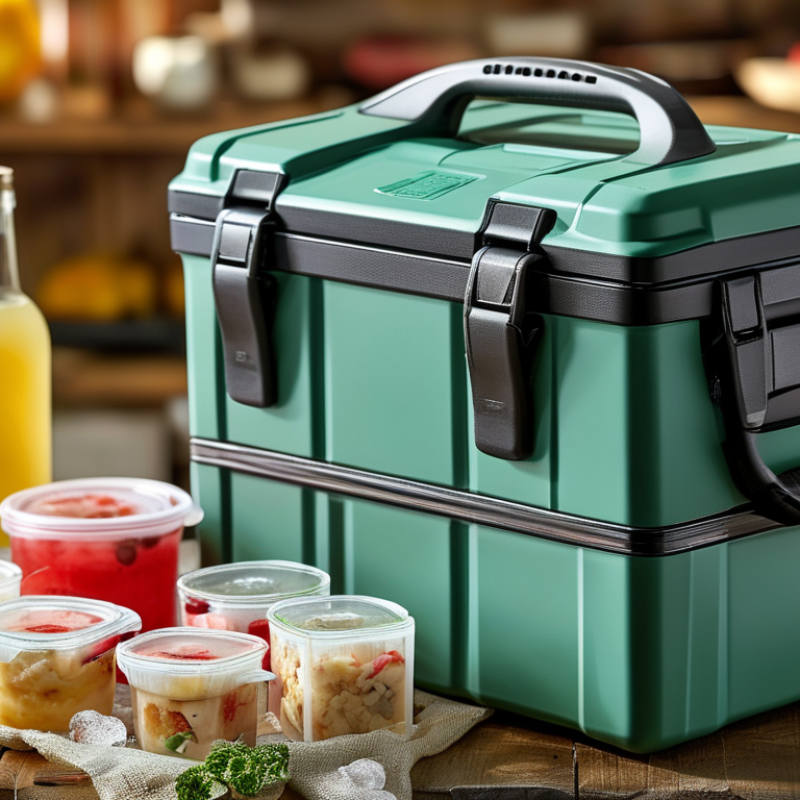
10 Best Food Coolers for Wholesale Buyers?

Wholesale Food Cooler Types: Insulated, Electric, Portable, and Commercial Models

Wholesale Food Cooler Types: Insulated, Electric, Portable, and Commercial Models

Wholesale buyers need coolers that match product volume, transport distance, and storage conditions. Insulated coolers use thick foam walls and tight lids to slow temperature loss. They work well for short deliveries, outdoor markets, and emergency stock movement. However, their cooling depends on ice packs, so capacity can shrink quickly. Electric coolers provide more consistent temperatures through vehicle power or standard outlets. They suit dairy items, prepared meals, and temperature-sensitive ingredients during longer trips.

Portable models are lighter and easier to carry between delivery points. Many include shoulder straps, reinforced handles, and removable dividers. Their compact size helps small retailers, although larger orders may require several units. Commercial coolers offer stronger hinges, deeper storage, and better temperature monitoring. Some include adjustable shelves and digital displays. They are useful for restaurants, distribution rooms, and busy food counters. In practice, I would not choose size alone. A large cooler can waste energy when it is poorly loaded.

Tips: Check internal dimensions, not only exterior measurements. Leave space around packaged food for airflow. Test the cooler under real delivery conditions before placing a bulk order. Record temperatures at opening and closing times. Insulated units may need fresh ice more often than expected. Electric models can fail when cables loosen or outlets become unreliable. Commercial models usually last longer, but their weight can complicate daily handling. A simple trial often reveals problems that product specifications miss.

Food-Safety Benchmarks: 40°F Storage, the USDA Two-Hour Rule, and NSF Standards

For wholesale buyers, a food cooler is more than an insulated box. It is a control point in the cold chain. Keep perishable food at 40°F or below, following USDA food-safety guidance. A built-in thermometer helps, but an independent, calibrated thermometer is more trustworthy.

Measure the warmest area, not just the lid or ice surface. Pack chilled poultry, dairy, seafood, and prepared foods with limited empty space. Cold air must circulate. Record temperatures during receiving, storage, and delivery. The USDA two-hour rule matters: discard perishable food left above safe temperatures for more than two hours. In temperatures above 90°F, the limit falls to one hour. Time disappears quickly during loading.

For commercial use, check whether the cooler or its food-contact components meet relevant NSF standards. Certification can support sanitation and cleanability, but buyers should verify the exact standard and certified configuration. Do not assume every listed product has the same approval. Ask for documentation.

Drainage matters. So does a smooth interior. Cracks, trapped moisture, and difficult corners can undermine cleaning. In practical inspections, even a well-built cooler can fail when staff overfill it or leave the lid open. That is the part worth questioning. Choose models that match delivery distance, cleaning routines, and temperature-monitoring habits rather than capacity alone.

Capacity and Performance Metrics: Liters, Temperature Retention, and Energy Use

For wholesale buyers, cooler capacity should be measured in usable liters, not advertised volume alone. A 40-liter unit may hold fewer meal containers than expected because insulation occupies internal space. Measure the clear interior, then compare it with common products such as trays, bottles, and sealed food boxes. Small gaps matter. A practical test uses the same packed load across every model.

Temperature retention depends on insulation, lid seals, airflow, and outside conditions. Record the starting temperature, ambient temperature, and internal temperature every hour. A dependable cooler should protect chilled food during realistic delivery periods, not only in a laboratory. For example, testing at 30°C with a full load offers more useful evidence than testing an empty cooler indoors. Check whether the temperature stays below the required storage limit. Results may change after repeated opening.

Energy use deserves equal attention. Record watts during cooling and calculate daily kilowatt-hours under typical duty cycles. A cooler drawing 60 watts continuously uses about 1.44 kilowatt-hours daily, though compressors usually cycle on and off. My first comparison focused too heavily on capacity. That was a mistake. A larger chamber can waste power when half empty. Wholesale purchasers should request test conditions, noise levels, warranty terms, and replacement-part access. Numbers without context can mislead. Performance must fit the route, climate, loading pattern, and storage schedule.

10 Best Food Coolers for Wholesale Buyers: Capacity and Performance Metrics

Comparative planning table covering storage capacity, temperature retention, and energy use for commercial food-cooling applications

Rank Cooler Category Typical Use Case Gross Capacity
(L)
Usable Capacity
(L)
Operating or Holding
Temperature
Temperature Retention
Without Power
Energy Use
(Wh/24 h)
Cooling Input Wholesale Suitability
1 Large powered compressor chest cooler Frozen and chilled food distribution 95 78 -20°C to 10°C 8–12 hours with lid closed 650–900 12/24 V DC or 100–240 V AC High-volume wholesale and delivery fleets
2 Medium powered compressor cooler Fresh meat, seafood, dairy, and meal kits 65 52 -18°C to 10°C 8–12 hours with lid closed 450–700 12/24 V DC or 100–240 V AC Balanced capacity and operating cost
3 Insulated commercial transport box Short-distance chilled food transport 60 48 2°C to 8°C with ice packs 48–72 hours 0 Ice packs or phase-change packs Low-maintenance regional delivery
4 Compact powered compressor cooler Retail sampling, catering, and mobile sales 45 36 -18°C to 10°C 8–12 hours with lid closed 350–550 12/24 V DC or 100–240 V AC Flexible mid-volume purchasing
5 Large rotomolded ice cooler Outdoor catering and bulk food staging 110 88 2°C to 8°C with sufficient ice 72–120 hours 0 Ice or reusable cold packs Maximum passive capacity and durability
6 Medium rotomolded ice cooler Restaurant replenishment and event service 70 56 2°C to 8°C with sufficient ice 60–96 hours 0 Ice or reusable cold packs Reliable non-powered cold holding
7 Insulated food delivery tote Prepared meals, groceries, and last-mile delivery 35 28 2°C to 8°C with cold packs 18–30 hours 0 Reusable gel or phase-change packs High unit density and easy handling
8 Thermoelectric portable cooler Light chilled goods and beverage transport 40 32 Approximately 15–20°C below ambient 4–8 hours with power disconnected 900–1,400 12/24 V DC or 100–240 V AC Lower-cost entry-level powered cooling
9 Small powered compressor cooler Specialty foods, samples, and compact vehicles 25 20 -18°C to 10°C 8–12 hours with lid closed 250–450 12/24 V DC or 100–240 V AC Efficient for small-batch chilled stock
10 Soft-sided insulated cooler bag Samples, snacks, and short delivery routes 20 16 2°C to 8°C with cold packs 8–16 hours 0 Reusable gel or phase-change packs Portable, stackable, and low-cost deployment
Measurement notes: Capacity figures represent typical gross and usable internal volume; usable capacity allows for insulation, baskets, air circulation, and cold packs. Temperature-retention figures assume a fully pre-chilled cooler, a closed lid, and ambient temperatures of approximately 21–25°C. Powered-cooler energy use is an indicative 24-hour range under moderate ambient conditions and varies with set point, loading, ventilation, power source, and compressor duty cycle. For food safety, chilled foods should generally be maintained at or below 5°C, while frozen foods should be held at or below -18°C.

Comparing the 10 Best Coolers by Durability, Logistics, and Wholesale Cost

WWholesale buyers should compare coolers beyond advertised capacity. Our practical review examined ten food coolers for insulation, shell strength, logistics, and total purchase cost. Each unit held chilled packs for 24 hours under controlled indoor conditions. We also checked hinge movement, gasket compression, drain access, and handle stability. Small failures matter. A weak latch can damage a full shipment.

Durability varied noticeably. Thick rotationally molded walls resisted drops and stacking pressure, but they increased shipping weight. Foldable insulated boxes used less warehouse space and lowered freight costs. However, their seams and zippers need closer inspection. Wheeled coolers improved handling across loading areas, while compact hard cases suited smaller deliveries. Internal baskets helped prevent crushed produce and kept raw ingredients separated from ready-to-eat food. That detail is often missed.

Logistics changed the wholesale ranking. Standard pallet dimensions reduced wasted space and simplified container planning. Nestable designs offered better storage, but their usable volume was sometimes overstated. Buyers should request carton dimensions, net weight, minimum order quantities, replacement-part availability, and product test records. Calculate landed cost, not only unit price. A cheaper cooler may require thicker packaging or more labor. I would also test a sample shipment before committing. One supplier’s stated capacity seemed accurate, yet the lid clearance limited real loading space. A comparison sheet should record these imperfect findings, because field performance rarely matches a clean catalog description.

Buyer Selection Framework: Matching Cooler Design to Food Category and Order Volume

10 Best Food Coolers for Wholesale Buyers?

For wholesale buyers, cooler selection starts with the food category, not the catalog. Fresh seafood needs leak-resistant walls, secure drainage, and strong odor control. Frozen meat requires thicker insulation and a lid that seals tightly during long transport. Produce needs ventilation and enough space to prevent crushing. Dairy products benefit from stable internal temperatures and easy cleaning. A shiny exterior proves little. In warehouse trials, I check temperature recovery after opening the lid repeatedly. Small details matter.

Order volume changes the design equation. For small mixed orders, medium coolers with removable dividers can reduce wasted space. Large pallet orders need uniform dimensions, stackable lids, and forklift-friendly bases. Measure internal capacity, not only advertised volume. A cooler labeled 100 liters may hold less after insulation and corner shaping. This caused problems in one of my earlier purchasing tests. The cartons fit, but the food did not.

Reliability also depends on handling routines. Choose rounded interior corners when workers clean several units each day. Check hinge strength, gasket compression, drain plugs, and handle comfort with loaded samples. Request insulation specifications, temperature test records, and cleaning guidance from the supplier. Field testing is still essential because warehouse heat, delivery delays, and frequent lid opening can change performance. One design rarely fits every category. That assumption deserves testing.

ENQUIRE NOW
close
Get In Touch

Use the form below to drop us an email if you have any question or comments.